

France’s 4.93% Bond Auction: How Higher Rates Squeeze Budgets and Business
France has not lost access to bond buyers. The yield required to attract them has risen, and the cost reaches maturing debt, future budgets and business investment at different speeds.
The squeeze concerns funding costs and room for policy choices. It does not establish a default or the closure of financing markets.
The bonds sold. The pressure was in the price
On October 1, 2026, France’s debt-management agency, Agence France Trésor, or AFT, allotted €11.999 billion of long-term OAT government bonds. The November 25, 2036 maturity cleared at a weighted-average yield of 4.93%, with bids twice the allotted amount. Buyers had not disappeared, but access was expensive. Those two conditions can coexist, and that coexistence explains the nature of France’s present financing pressure.[1]
October 1 OAT auction: different terms across maturities
Weighted-average yields on one auction date. Different maturities mean the gaps are not differences in issuer credit.
Yield (%); zero baseline, maximum 6%
AFT, October 1, 2026. Coupons also differ by security. These are not live trading quotes.[1]
A government can keep borrowing while losing room to choose how to spend. Interest competes with other uses of the same budget. Yet the yield on a bond issued today does not instantly reset every outstanding security. The new cost first reaches refinancing and additional funding needs, progressively replacing older, cheaper finance. A fast market repricing and a slower budget squeeze are therefore different stages of the same process.
An auction yield records the terms on which investors accepted the securities. Pricing reflects not just government credit but euro-area rates, inflation expectations, maturity, alternatives and tradability. One elevated yield cannot identify what proportion represents distrust of fiscal policy. The auction supplies concrete evidence of expensive financing; it is not a complete statistical decomposition of the reasons for that price.
The pressure is not a binary choice between safety and immediate default. Market access may continue while decisions over taxes, benefits, public investment and procurement become harder. Bondholders, taxpayers, companies and prospective household borrowers encounter different costs at different times. The useful question is whose contract or budget resets next, rather than whether the entire country suffers an identical loss at once.
SG Group View: market access is not fiscal freedom
SG Group sees this episode first as a contraction of policy room, before any conclusion about interrupted funding. Access asks whether the state can sell the amount it needs. Fiscal freedom asks what remains available after paying the cost. Strong enough bidding can preserve access while high yields erode discretion. Treating a cleared auction as complete reassurance, or a high yield as proof of a shut market, misses the intermediate stage.
Three clocks organize the analysis: market repricing, debt refinancing and budget adjustment. The same shock runs through them at different speeds. A calm trading day need not erase refinancing costs, and abrupt spending cuts need not improve long-run credit. Identifying which clock has begun to move is more informative than tracking a yield alone. It allows genuine constraints to be examined without either alarmism or premature reassurance.
Three clocks carry the rate squeeze
Market repricing does not reach contracts and budgets simultaneously.
- Market clockPrices move first
Yields, valuations and collateral conditions can change.
- Refinancing clockContracts turn over
Maturities and new needs transmit the funding cost.
- Budget clockAllocations adjust
Interest, receipts and outlays change policy room.
A mechanism diagram, not a forecast assigning fixed durations to the stages.
The second axis separates common interest-rate pressure from France-specific financing conditions. Domestic reform cannot eliminate every component of a shared rate increase. Equally, common monetary easing need not resolve a wider country premium. The appropriate response depends on the driver. When judging budget policy, attributing every decline in yields to the government, or every rise to its failure, would confuse the instrument with the environment.
The third axis distinguishes the size of adjustment from its quality. Equal near-term savings can have different consequences if one removes inefficiency and another cuts productive assets or skills that support future revenue. Passing a budget is not the final test. Implementation, receipts, investment and nominal economic growth determine whether an initial improvement in confidence can be sustained.
Policy rates, auction yields, indices and interest bills differ
On September 10, 2026, the European Central Bank raised its key rates by 25 basis points, taking the deposit-facility rate to 2.50% from September 16. That rate operates short-term euro-area monetary conditions. The 4.93% auction yield prices a specific long-term French security. The two observations do not represent identical dates, maturities or instruments, so their difference cannot simply be labelled France’s credit premium.[6]
What four different numbers measure
Keep dates, coverage and units attached rather than combining these into one rate.
On narrow screens, scroll horizontally within this table only.
| Measure | Date or coverage | Value | Interpretation |
|---|---|---|---|
| ECB deposit rate | Effective September 16 | 2.50% | Short-term policy rate |
| 2036 OAT auction | October 1 | 4.93% | Pricing of one long-term security |
| TEC 10 | October 2 | 4.90% | Constant-ten-year reference index |
| State debt charge | 2027 budget proposal | €72.9 billion | Period expenditure; planned |
ECB and AFT. Different dates and units prevent a meaningful ranking on one bar chart.[3][6][11]
AFT’s TEC 10 reference index standardizes the maturity at ten years; its October 2, 2026 observation was 4.90%. An auctioned bond has a fixed redemption date, whereas the index provides a constant-maturity market reference. The proximity of 4.93% and 4.90% is informative, but differences in instrument, calculation and timing prevent them from being identical prices—or a measure of trading profit between the observations.[11]
An interest bill is a euro amount recognized over a budget period, not a yield percentage. It depends on debt coverage, issuance dates, coupons, inflation linkage and accounting. A large move in market yields need not translate proportionately into next year’s expenditure. Conversely, a stable market can still produce higher costs when substantial debt reaches refinancing. Comparing new terms with outstanding contracts is the starting point for translating rates into money.
The guide to rates, households and firms explains basic contractual transmission. France’s distinctive issue is that national long-term funding terms and fiscal room can move independently within a shared monetary policy. Bank-loan pricing also depends on bank funding, borrower credit and contractual maturity. Passing through those intermediate stages avoids treating an OAT yield as a universal rate for businesses and homebuyers.
A €340 billion issuance plan is not €340 billion of new deficit
AFT plans €340 billion of medium- and long-term issuance in 2027, net of buybacks. “Net” here means after subtracting repurchases, not after deducting all scheduled redemptions. Governments issue securities to repay maturing debt as well as to fund new deficits. Treating issuance as an equal amount of additional deficit or debt-stock growth would misclassify the substantial refinancing component.[2]
Funding needs include principal redemptions, cash management and other financing items as well as the deficit. A year with more maturities can require more market borrowing despite an improving deficit. That does not render fiscal consolidation pointless. It means today’s deficit reduction does not instantly change the maturity schedule of yesterday’s borrowing. Separate ledgers for new fiscal decisions and contracted refinancing help evaluate policy without conflating the two.
One successful auction does not settle the terms of an entire year’s refinancing. Different maturities, methods, bills and buybacks combine to secure cash across the calendar. Demand also reflects insurers’ liability matching, banks’ collateral requirements and foreign investors’ currency management. The relevant resilience is sustained access under varying conditions, not an assumption that the government can complete all borrowing on one exceptionally favourable day.
The 2027 numbers remain plans rather than outcomes or completed individual issues. AFT says details of its medium- and long-term programme are due in December 2026.[2] Budget legislation and market conditions can alter the practical context. The combination of what is redeemed, how long replacement debt runs and which costs become fixed is more useful than the headline issuance amount alone.
The interest bill reaches the next budget’s choices
AFT’s budget explanation updates the state’s 2026 debt charge to €62.6 billion and projects €72.9 billion for 2027, compared with €59.3 billion in the initial 2026 budget. These are estimates of the state budget’s debt charge, not a realized series of interest paid by the entire general-government sector. The upward revisions nonetheless show more budget space being claimed by debt costs and, consequently, pressure on other choices.[3]
State debt charge: 2026 revision and 2027 plan
A comparison of estimates reported together, not realized expenditure.
€ billion; zero baseline, maximum 80
AFT’s September 2026 plan and update. These are state budget charges, not general-government realized costs.[2][3]
An increase in debt costs does not automatically cut every other item by an equal amount. A government can combine revenue measures, spending restraint, a larger deficit, asset transactions or cash use. Each has different implications for demand, distribution and future obligations. A claim that higher interest will cause a particular amount of investment cuts therefore requires the actual allocation. The squeeze tightens a constraint; it does not predetermine every budget line.
Businesses may encounter the adjustment through orders and payment terms. Delayed projects, altered subsidies or smaller local plans can change demand for construction, equipment and services. If procurement is preserved instead, the first burden may shift to taxpayers or other spending. Linking sovereign borrowing costs to corporate earnings therefore requires both a financing channel and a budget-to-order-book channel.
Rates are not necessarily the sole reason for a higher estimate. Debt volume, issue prices, inflation linkage and accounting recognition also matter. Reducing the revision to one yield change would distort future comparisons. Likewise, a calmer interest bill may reflect temporary accounting effects or a sustained improvement in funding. The budget charge is an important outcome indicator, but maturity and issuance information are needed to trace its causes.
An eight-year maturity buffer is not an eight-year wait
At September 30, 2026, AFT reported an average remaining maturity of eight years and 158 days for negotiable state debt. That helps explain why older low-cost securities do not all immediately acquire new terms. An average does not reveal each year’s redemptions, however. Some debt matures soon and some much later. The figure is neither an eight-year borrowing holiday nor an eight-year delay before higher rates have any effect.[4]
The buffer spreads the impact of a shock. Keeping fixed terms outstanding makes some costs more predictable. But after locking in a high yield for a long period, a subsequent market decline does not necessarily allow immediate cheaper replacement. Extending maturity exchanges refinancing frequency for cost fixation; it does not abolish rate risk. More long-term issuance is therefore not automatically the least expensive strategy in every environment.
Short-term funding resets more frequently. Moving toward bills when long-term rates are high may reduce today’s rate, but it increases the need to return to the market soon. If conditions deteriorate, both pricing and access must then be managed more often. A continuing borrower has reason to maintain maturity diversification and market depth rather than concentrate only in whichever part of the curve temporarily looks cheapest.
Companies cannot simply borrow the government’s average-maturity reassurance. Their scale, market access, redemption dates and cash buffers differ. A firm with recently completed investment and long fixed financing faces a different timetable from one with a major repayment next year. Moving from national averages to individual maturities and cash flows helps identify where pressure on hiring or investment might emerge first.
Why a 3.70% coupon can clear at a 4.93% yield
The 2036 OAT auctioned on October 1 carries a 3.70% coupon and cleared at a weighted-average price of 90.38% of par. Its 4.93% yield does not mean the issuer rewrote the coupon. Buyers acquire it below face value and receive contractual interest and redemption. The relationship between purchase price, future payments and remaining time determines yield. Conflating the coupon with financing terms can misstate the cost in either direction.[1]
Issuing below par delivers less cash for a given face amount and leaves a difference relative to eventual redemption. Looking only at a modest coupon ignores that cash-funding feature. Conversely, treating the entire discount as interest paid in the current year would misread accounting and timing. Face value, cash received, coupon payments and redemption need to be placed in contractual order before assessing financing cost.
The distinction also matters for public-debt statistics. A falling market price reduces a holder’s valuation, but does not automatically reduce the face amount the government has promised to redeem. A bondholder’s mark-to-market loss is not a sovereign debt reduction. A buyback would be a separate transaction. Different issuer and investor balance sheets also explain how a market movement can travel toward banks and insurers without changing contractual principal.
A higher yield can improve future income on newly invested funds while depressing the price of older low-coupon holdings. Investors able to hold against matched liabilities differ from those needing cash for redemptions or collateral. Bond investors neither uniformly benefit nor uniformly lose. Acquisition timing, liability maturity and liquidity requirements determine how the higher-rate environment reaches their balance sheets.
Inflation can dilute debt and raise its cost
Inflation can increase nominal revenue and GDP, potentially containing the ratio of fixed debt to output. It is not an automatic debt solution. New investors may demand greater yield compensation, and indexed payments can rise. The route through a larger denominator and the route through higher budget costs operate simultaneously. Their balance depends on contractual structure, expenditure design and actual economic growth.
The Banque de France’s June report noted that around a tenth of the debt takes the form of inflation-linked bonds.[7] Unlike conventional fixed-coupon instruments, part of their calculation responds directly to prices. Such securities diversify funding and investor demand, but also create a route from inflation into fiscal costs. Comparing only historical coupons would not establish that they are always the cheaper form of issuance.
For households and firms, rising nominal income is not identical to relief. Materials, wages and working-capital needs can grow faster than sales, leaving cash tight. Savers can receive more interest yet lose purchasing power if wages or returns lag prices. The inflation and purchasing-power guide provides the basic distinction between a larger nominal amount and an improvement in what it can buy or finance.
France cannot independently change the euro’s value or set its own national policy rate. Fiscal and productive adjustments occur within common monetary conditions. A shared currency brings market depth and exchange-rate stability advantages, but limits unilateral monetary responses to country-specific fiscal stress. That institutional structure makes fiscal credibility and real economic capacity joint questions, rather than interchangeable policy levers.
The 119.0% debt ratio covers more than state bonds
Insee’s September 29, 2026 release put Maastricht general-government debt at €3.5955 trillion, or 119.0% of GDP, at the end of the second quarter. This consolidated measure includes central government, local government and social-security entities. Its perimeter differs from AFT’s negotiable state debt. The totals cannot be added, nor can one state-bond yield be mechanically applied to the other measure’s entire stock. Coverage must be aligned before assessing scale.[5]
General-government debt: quarters from one release
Debt stock as a share of GDP, using consistent general-government coverage and quarter ends.
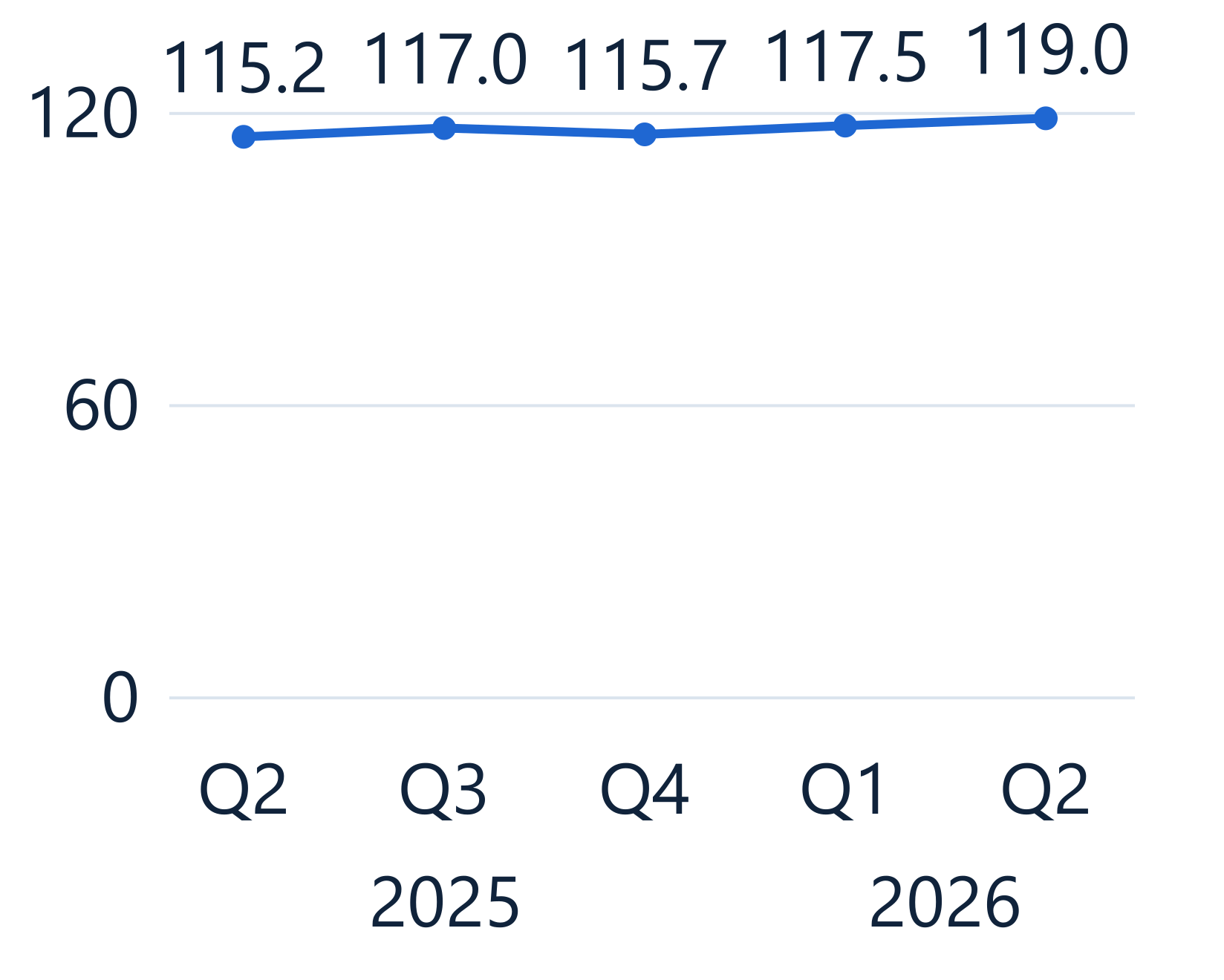
Share of GDP (%). Vertical axis 0–125%; quarters equally spaced.
Insee, September 29, 2026 release. Lines connect adjacent quarterly observations; they do not represent daily measurements.[5]
The ratio compares a debt stock with the scale of annual economic activity. It can rise with unchanged debt if GDP falls, or be contained by nominal GDP growth. A high ratio informs sensitivity to financing conditions, but is neither the amount payable next year nor a mechanical default threshold. Assets, revenue capacity, maturity and rate structure prevent a single ratio from yielding a reliable date for a crisis.
Quarterly debt increases and deficits also need not coincide. Cash movements, financial-asset transactions and liabilities outside the debt measure bridge the two. Borrowing can build a cash buffer; using existing cash can fund a deficit without equal new issuance. Reading financing uses and balance-sheet movements together prevents the debt-ratio path from being attributed wholly to one fiscal decision or from concealing changes in liquidity.
The ratio matters because small differences between financing costs and growth can accumulate on a large base. Replacing cheaper contracts with more expensive ones can then have substantial fiscal consequences. Those consequences still pass through refinancing. The chart’s increase is background for future fiscal room, not a direct conversion into an extra interest payment today. Keeping market and accounting clocks distinct produces a more useful reading of risk.
A debt snowball requires matching growth and effective cost
Debt dynamics depend on more than the balance excluding interest. If the effective cost of outstanding debt exceeds nominal growth, containing debt relative to the economy becomes harder; the reverse helps. The relevant interest measure is the effective average cost of the debt stock, not one day’s ten-year auction yield. Growth must also be nominal, including prices. Using only real growth would mismatch the quantities.
Improving the primary balance is an important route to limiting future borrowing. If abrupt adjustment sharply reduces demand, output and receipts, it can offset part of the intended gain. That is not an argument for preserving every expenditure in the name of growth. Which taxes or outlays change, and when their effects arrive, matter. The composition of consolidation needs to be assessed alongside its headline size.
Inflation can improve the debt ratio’s denominator while households feel worse off. Conversely, better price stability can ease everyday uncertainty while slower nominal growth complicates ratio reduction. Living standards and a fiscal ratio are not the same objective measured in the same units. Stable purchasing power, revenue-supporting employment and sustainable funding need to be considered together, lest improvement in one metric be mistaken for improvement in all three.
Sustainability also depends on the response when forecasts miss. Markets care how revenue shortfalls are managed and how long expensive funding can be absorbed. A plan whose arithmetic works only under optimistic growth, rate and revenue assumptions offers limited resilience. Explaining what remains viable when those conditions change provides a stronger account of policy than presenting a small deficit under one favourable forecast.
Banks face valuation, funding and collateral channels
The impact of lower bond prices on bank income and capital depends on the holding purpose and accounting category; not every decline becomes the same recognized loss on the same day. Assets that must be sold, or securities used as collateral, can still affect cash availability. Because sovereign bonds serve liquidity and collateral functions, their pricing matters for banks’ daily funding practices as well as their share prices.
More expensive bank funding can place pressure on new business-loan terms. Sovereign and bank borrowing rates are not identical, but can interact through shared investors and financial conditions. Pass-through depends on competition, credit risk and deposit funding. Rather than add the OAT yield change mechanically to every loan, the analysis needs to connect the bank’s funding side with its lending side.
In short-term secured finance, price changes can lead to collateral or cash demands. Sales to meet those demands can then amplify the original move, creating a loop beyond the initial credit assessment. The Banque de France’s June report highlighted short repo maturities, concentrated transactions and leveraged investors as stability concerns.[7] Such amplification should neither be attributed entirely to fiscal deterioration nor dismissed as irrelevant speculation.
These channels do not establish that banks will immediately stop lending, but they justify watching both prices and quantities. Some firms obtain expensive credit; others face tighter collateral or maturity requirements; others borrow less because demand is weak. A lower loan balance cannot by itself distinguish restricted supply from weaker demand. Rates, approvals, contractual terms and actual borrowing must be examined together.
For firms, the danger is financing pressure meeting weaker orders
A firm with long fixed financing may see no immediate monthly payment change from an OAT sell-off. Floating loans, short working-capital facilities and large upcoming maturities can transmit pressure sooner. Exporters, public contractors and domestically oriented businesses also face different revenue channels. A shared national label is insufficient to estimate a uniform effect on financing costs or profits.
The difficult combination is higher costs arriving when cash receipts weaken. Delayed procurement, postponed customer purchases and inventory accumulation can require funding independently of interest. The revenue, profit and cash-flow guide explains why profitability does not prevent a liquidity shortage. In this episode, reset dates, customer collections and investment payments belong on the same timetable, rather than in separate readings of the income statement.
Large companies may choose market maturities, use several banks or have fixed terms earlier. Smaller firms can have fewer lenders and negotiations centred on collateral or guarantees. Neither category is uniformly safer: cash buffers and business stability matter. Yet fewer alternatives can become more consequential when national financing conditions tighten. Comparisons should therefore include available routes and maturity concentration, not just average borrowing rates.
Equity analysis separates earnings effects from discount-rate effects. Higher rates can make future cash less valuable today, while some businesses improve operating income. Banks, insurers, cash-rich firms and persistent cash users face different combinations. The business-valuation guide provides the analytical background. An OAT yield increase is not a trading rule for every share; company-specific earnings and financing conditions still determine the assessment.
Housing separates existing fixed contracts from new buyers
The Banque de France’s July figures put the rate on new mortgages excluding renegotiations at 3.30%. Fixed-rate loans represented 99.4% of mortgage production excluding bridging loans. That is a July flow measure, not a statement that 99.4% of the outstanding stock has that structure. It also predates the October OAT auction, so it cannot demonstrate an immediate increase in every household’s payment. Contract type and observation month must remain attached to the figures.[8]
An existing fixed contract may protect the agreed monthly payment from a market move. A prospective buyer instead faces both the bank’s current terms and the property price. Falling prices need not improve affordability if financing tightens. Deposits, income, term and maintenance expenses also matter. Housing pressure can therefore emerge through access for new buyers, rather than through an identical payment increase for every existing borrower.
If sellers retain earlier price expectations while buyers can borrow less, transaction times may lengthen first. Lower turnover can weaken demand for agents, renovations and furnishings. Developers may continue paying for work and inventory while sales and receipts are delayed, bringing financing and sales clocks together. Housing transmission is thus broader than a property-price forecast: turnover and cash conversion reveal how related businesses can be affected.
Renters are not insulated from the wider economy, but rents do not automatically rise in proportion to market rates. Supply, local demand, income and contractual or regulatory conditions mediate the result. Deferred buyers remaining in rentals and weaker employment reducing housing demand can push in different directions. One average mortgage rate cannot explain the circumstances of owners, prospective purchasers and tenants simultaneously.
A borrower’s cost can be another investor’s income
Higher rates can increase nominal income for new bond buyers, depositors or cash-rich companies. That does not turn a larger public interest bill into a gain for the economy as a whole. Taxes and expenditures may adjust, while recipients differ in location, spending behaviour and inflation exposure. Mapping the payer alongside the recipient reveals distributional effects hidden by the phrase “the national economy.”
One rate increase has different recipients
New rates do not reach everyone at the same speed.
Borrowers
Refinancing and new-credit pressure
Fixed terms and time to maturity matter.
New savers and investors
Potentially higher nominal income
Inflation, taxes and losses on old holdings remain separate.
Budget-dependent users
Allocation or timing may change
Actual policy decisions and execution mediate the effect.
A conceptual distribution diagram, not an estimate of amounts or probabilities.
Public-service users and contractors can be affected without paying interest themselves, through a change in priorities. Delayed expenditure, cancelled activity and replacement funding produce different outcomes. There is no basis for subtracting an increased interest bill mechanically from one welfare programme or investment line. Legislative choices and implementation determine where the pressure ultimately lands.
Even a saver earning more interest may face changing taxes or prices. Someone without personal debt can be affected through employer investment or public services. The simple opposition between savers and borrowers is therefore incomplete. Financial assets, income sources, housing and service use combine to determine exposure. Asking whose resources are squeezed makes the rate discussion concrete without assuming a uniform national outcome.
Fiscal adjustment must preserve the capacity to generate revenue
Expenditure and tax changes may be needed to restore credibility. Equal headline improvements can operate differently when achieved by administrative savings, stronger collection or cancellation of activity. Cutting investment may reduce this year’s funding need while weakening productive capacity and future revenue. The long-run debt effect is not mechanical. Adjustment quality asks how immediate savings interact with the future ability to generate income.
Calling an item public investment does not establish its productivity. Actual use, maintenance costs, completion time and its relationship to private activity matter. Financing costs can arrive before benefits, and delays or overruns change the original assessment. An explicit timetable and measurable outcomes support credibility more effectively than a large investment headline alone.
Tax-rate changes also cannot be evaluated solely on an unchanged base. Income, consumption, investment and location decisions can alter receipts relative to budget assumptions. This is not a claim that tax increases necessarily fail; it is a reason to assess design and behavioural response together. Credibility requires tracking the gap between expected revenue and receipts after implementation.
The guide to weaker growth, businesses and jobs explains demand transmission. France’s distinctive constraint is maintaining fiscal trust and a growth base without independently easing the shared monetary stance. Neither spending more nor cutting more is an all-purpose solution. An implementable combination must be evaluated against both budget arithmetic and the economy’s capacity to support credit.
An ECB safeguard is not an unconditional funding guarantee
The ECB’s Transmission Protection Instrument addresses unwarranted, disorderly market dynamics threatening monetary-policy transmission. It is not a promise to cap a state’s financing costs at a permanently low level. Activation involves a comprehensive assessment, including fiscal sustainability and compliance with EU frameworks. The existence of the instrument does not establish an automatic yield trigger, nor does it remove the need for a credible national budget.[9]
An excessive-deficit procedure does not, by itself, create a universal TPI exclusion. The published criteria include either not being subject to the procedure or not being assessed as having failed to take effective action in response to recommendations. Policy compliance and sustainability still need assessment. Preserving the actual eligibility language avoids understating safeguards through an overly broad interpretation of a procedural label.[9]
The Council’s January 2025 recommendation called for France to correct its excessive deficit by 2029.[10] That dated institutional recommendation is not proof that a current budget proposal will achieve it. National plans, EU assessments and market yields are separate judgments. Auctions occur now even when deadlines are years away; enacted plans can also diverge from actual receipts and expenditure. Procedure must therefore be followed through to execution.
Containing disorderly trading and making a budget sustainable over time are different functions. Better liquidity need not erase expensive refinancing, while improving fiscal fundamentals need not prevent a sudden liquidity shock. Treating safeguards and fiscal action as complements clarifies responsibilities. Neither the claim that a central-bank facility solves every budget problem nor the claim that such facilities are irrelevant captures their distinct roles.
The effects travel through the euro and cross-border capital
French sovereign holders extend beyond domestic households and banks. International investors compare other bonds, currencies and insurance or pension liabilities. An attractive euro yield need not translate into the same home-currency return after hedging costs or exchange-rate changes. Conditions attracting fresh funds can differ from those prompting existing holders to reduce exposure, so a single yield cannot determine cross-border flows.
A weaker euro can improve translated foreign revenue while increasing imported fuel or component costs. Higher French yields do not guarantee a stronger euro, and fiscal concern does not guarantee depreciation: other members and the ECB influence the shared currency. The exchange-rate and business guide helps connect sales currencies, cost currencies and contractual fixing periods without jumping directly from sovereign yields to corporate profits.
Bond absorption conditions are changing elsewhere too. The existing Bank of England QT analysis explains reduced central-bank holdings and duration transfer in Britain. Different currencies, central banks and fiscal arrangements prevent its sale volumes or yield conclusions from being transplanted to France. The useful comparison is how much duration private investors absorb and the compensation they require for doing so.
International transmission does not establish that French fiscal developments dominate world markets. Shared energy, monetary or growth factors can move several markets together. Observed co-movement calls for a comparison between a French-origin shock and separate responses to a common driver. Announcement timing, contracts and investor channels help distinguish causality from correlation.
Four combinations distinguish relief from persistent pressure
Putting common monetary conditions alongside domestic fiscal implementation creates a broader outlook than asking only whether yields rise or fall. Falling common rates and effective budget improvement can help both new funding terms and country credibility. Outstanding contracts still turn over gradually, so the budget need not improve on the same day. The next test is whether market relief reaches the effective cost.
Common rates meet domestic implementation
Compare conditions that change the assessment without assigning probabilities.
Two sources of relief
New terms and country credibility may improve; effective-cost lags remain.
Limited room
A country premium can offset some benefit from easier common rates.
Credibility improves, costs stay high
Domestic progress still has to absorb an expensive common environment.
Overlapping pressure
Funding costs and doubts about future revenue can intensify together.
SG Group’s conditional comparison. None is an unconditional forecast.
Credible domestic execution can coexist with expensive funding if common inflation or long rates remain elevated. Improved policy assessments and a rising interest bill are therefore not necessarily contradictory. Conversely, easing common rates may offer limited relief if fiscal implementation disappoints and a country premium persists. Distinguishing the improving axis prevents external assistance from being confused with domestic success, or vice versa.
The difficult combination is persistent common rate pressure together with growing doubts about budget execution: new financing terms and expectations of future revenue may deteriorate together. The matrix assigns no probabilities. It organizes testable conditions rather than declaring a crisis inevitable. Subsequent auctions, legislation, execution and investment determine which combination the evidence supports.
The next useful observations arrive on different calendars
An auction shows market access and price on its date, while budget execution records actual receipts and expenditure. Neither alone establishes whether the squeeze is easing. Subsequent auctions should be read through yields, amounts and coverage for comparable securities; annual funding through average costs and refinancing. More bids can coexist with worse prices, making joint price-and-quantity observation essential.
Observations and the questions they can answer
Follow markets, plans, execution and contracts as distinct evidence.
On narrow screens, scroll horizontally within this table only.
| Observation | What it mainly tests | What it cannot establish alone |
|---|---|---|
| Bond auction | Price, volume and dated access | Average cost of the entire stock |
| Matched-maturity comparison | Changes in relative premium | Exact domestic political contribution |
| Refinancing and maturity mix | Timing of cost transmission | Realized receipts and growth |
| Budget execution | Actual receipts and outlays | All current loan conditions |
| New credit and business activity | Private-sector transmission | Causality from one auction |
An evidence map. Lagged series require separate observation periods and release dates.
AFT plans to publish the detailed 2027 issuance programme in December 2026.[2] Its maturity composition matters alongside the annual amount. Longer issuance can spread refinancing, but greater duration compensation may increase the initial cost. Stability and cheap funding are not always simultaneously maximized, so the allocation across maturities belongs in the assessment.
Insee schedules third-quarter debt data for December 18, 2026.[5] That quarter-end stock includes a period preceding the October auction and does not isolate its effect. Publication lags can reveal a worsening debt ratio after a calm market day, or an improving ratio without cheaper current refinancing. Aligning observation periods helps explain apparent contradictions between markets and later statistics.
Bank and housing observations need loan conditions and demand as well as average rates. Firms unable to refinance may be poorly represented in a new-loan average. Lower borrowing can reflect weaker demand or restricted supply. Following contract resets together with activity avoids attributing investment or employment changes to one sovereign auction and identifies where transmission has actually occurred.
The core squeeze is reduced choice, not a declaration of collapse
The auction showed that France could obtain funding, not that it could do so cheaply. The 2027 plans make funding and interest costs central constraints, but remain plans rather than outcomes. Treating market prices, government plans and private contracts as distinct stages allows reassurance about access and concern about cost to coexist. Neither observation has to be discarded.
SG Group’s assessment strengthens if expensive refinancing persists and reaches fiscal and corporate costs. It should be revised if common rates stabilize, implementation supports credibility and the effective-cost increase is contained. Stronger nominal growth or receipts would also alter the judgment. Stating the conditions for revision keeps today’s auction from becoming an unconditional claim about the future.
Reading France as squeezed by rates means recognizing changed costs of maintaining policies, not forecasting default. Those costs are distributed through refinancing, taxation, expenditure, credit and investment. Moving from the market’s fast clock to slower budgets and contracts turns an alarming headline into economic changes that can be examined and tested.
Frequently asked questions
Does 4.93% apply to all French debt?
No. It is the auction yield of a specific 2036 OAT on October 1. It reaches average costs through new issuance and refinancing, not a simultaneous reset of outstanding fixed contracts. Applying it to all general-government debt would mismatch both coverage and timing.
Does a 3.70% coupon mean financing costs only 3.70%?
The coupon specifies contractual payments on face value. Issuing below par changes the cash received relative to eventual redemption. Yield incorporates the purchase price and future payments, so a coupon alone does not describe the full financing terms.
Is €340 billion the new deficit for 2027?
No. It is planned medium- and long-term issuance net of buybacks. It finances maturities and other needs as well as new borrowing. It is neither the new deficit nor issuance net of all redemptions. The funding plan’s definitions and uses matter.
Does long average maturity remove near-term pressure?
Long maturity locks in some terms, but annual redemptions and new funding needs remain. An average is not a single common maturity date. Short-term debt and inflation-linked contracts create additional transmission routes.
Will existing mortgage payments immediately increase?
Existing fixed contracts may keep agreed payments unchanged. New borrowers or contracts requiring revision are different. July’s fixed-rate share describes new production, not the entire stock or terms after October’s auction.
Must the ECB lower high French yields?
There is no such guarantee. TPI addresses disorderly dynamics threatening policy transmission and requires an assessment of conditions. It is neither unconditional funding replacing fiscal action nor a promise to cap a particular yield.
Does a fall in bond prices reduce government debt?
Lower market valuation and lower contractual redemption are different. An investor’s loss does not automatically reduce the issuer’s principal obligation. A buyback would be a separate transaction whose price and funding must be examined.
What evidence would support a weaker squeeze?
Improved new funding terms should reach effective costs, budget execution or credit conditions. A one-day yield decline is insufficient without refinancing and revenue evidence. Whether relief comes from common rates or the country premium also changes the interpretation.
Sources and references
- Agence France Trésor — Long-term OAT auction resultsOctober 1, 2026
- Agence France Trésor — 2027 financing needs and resources; 2026 updateSeptember 29, 2026
- Agence France Trésor — Budget de l’État2027 budget proposal and 2026 update
- Agence France Trésor — Outstanding negotiable government debt and maturityAs at September 30, 2026; updated October 1
- Insee — Quarterly Maastricht general-government debtPublished September 29, 2026; Q2 2026
- European Central Bank — Monetary policy decisionsDecision September 10; effective September 16, 2026
- Banque de France — Financial stability reportJune 2026
- Banque de France — Loans to individuals, July 2026Published September 7, 2026; July data
- European Central Bank — The Transmission Protection InstrumentJuly 21, 2022
- Council of the European Union — Recommendations under the excessive deficit procedureJanuary 21, 2025
- Agence France Trésor — TEC 10 daily indexIndex observations for October 1–2, 2026
- Agence France Trésor — Government debt productsExplanation of government debt products